
Three Meanings of Pocahontas County Property Value
Three numbers sit inside one parcel record, and they answer different questions. The assessed value drives the tax roll. The appraisal fields split worth between land and building. The sale price records one past transfer on its own deed date. West Virginia's general rule sets assessed value at 60 percent of fair market value, but that ratio never turns an assessment into a current estimate of what a buyer would pay today. Keep each figure with the valuation cycle it belongs to, since blending them is the fastest way to misread a Pocahontas County property value.
| Value | What It Is | Where |
|---|---|---|
| Assessed value | Tax assessment figure, generally 60% of fair market value | WV Assessment / tax roll |
| Appraisal fields | Land, building and total appraisal amounts in the parcel record | Assessor search |
| Last sale price | Reported price for a recorded past transaction | Assessor sales history and deed |
| Land and building values | Components used to describe the parcel's appraisal | Assessor parcel card |
The 60 percent ratio is a statewide framework, not a promise that any single parcel's assessment matches its market price. A recorded sale works better as historical context, so check its date, acreage and property use before leaning on it. For the tax bill itself, class, exemption and appeal details, use the separate Pocahontas County property tax records guide.
Pocahontas County Property Value Date: July 1
West Virginia fixes ownership, use, and value each July 1. That snapshot governs the next calendar tax year. Pocahontas County applies the same rule. Its current notice states that 2026 assessment data was collected on July 1, 2025. The gap explains a fresh recorded price sitting beside an older assessment. For any sale after July 1, the county's tax-map notice points the reader to the parcel's "View Mapcard (Sales History)" PDF.
Set the assessment year beside the deed's sale and recording dates before drawing conclusions. A mapcard may surface a later sale lead. Yet the clerk's recorded instrument remains the record to read for grantee and legal description. Treat an older assessment as a dated snapshot, not a current market quote.
The 60 Percent Rule in Pocahontas County Property Value
West Virginia's general rule assesses property at 60 percent of fair market value. The state publishes an assessment-ratio study and its valuation methodology under W. Va. Code §11-3-1(d). That framework explains why the assessed figure runs lower than a full market-value concept. It does not mean any individual parcel was appraised at its precise sale price. Nor does the ratio predict what a buyer will offer.
Keep the assessment's class, use and date attached to the number. The question may be what a parcel might sell for now. The tax roll cannot answer it. The question may instead be the tax bill. Then read the account and class. The appraisal field is not the bill itself.
Looking Up a Pocahontas County Value Record
Search WV Assessment by street, owner, map, parcel, full parcel ID or legal description. Open the matching card and read land appraisal, building appraisal, total appraisal, sale date, sale price and deed reference together. Those fields only make sense as a set. The portal's Appraisal/Sales mode adds min and max filters for several value and sale fields. Those include calculated and deeded acres. An empty result often just means the search key was formatted differently. So try the parcel or legal-description field before concluding a Pocahontas County value record is missing.
- Select Pocahontas County and search by address, owner, parcel, map or legal description.
- Open the card and note the tax year, land/building appraisals and total.
- Review sale date and price fields, then locate the corresponding deed reference.
- Compare only like parcels, uses and dates; no verified comparable-sales report was located.
- Assessed value
- The figure used for property taxation under the state assessment rule.
- Fair market value
- A value concept used to set the statewide assessment relationship, not a guaranteed sale price.
- Sale / consideration price
- The reported amount tied to one recorded transfer.
- Reassessment date
- July 1 ownership, use and value point for the next tax year.
Assessor Fields for Pocahontas County Property Value
The assessment portal's Appraisal/Sales mode exposes min and max fields for land appraisal, building appraisal, calculated acres, sale date, total appraisal, sale price and deeded acres. Advanced search adds mailing address, deed book and page, legal description, building year, structure counts and area. Those filters narrow a set of values. They can also track down a parcel whose street label is uncertain. The terminology stays the portal's own throughout. The WV Assessment Search screenshot below shows the real field groups.
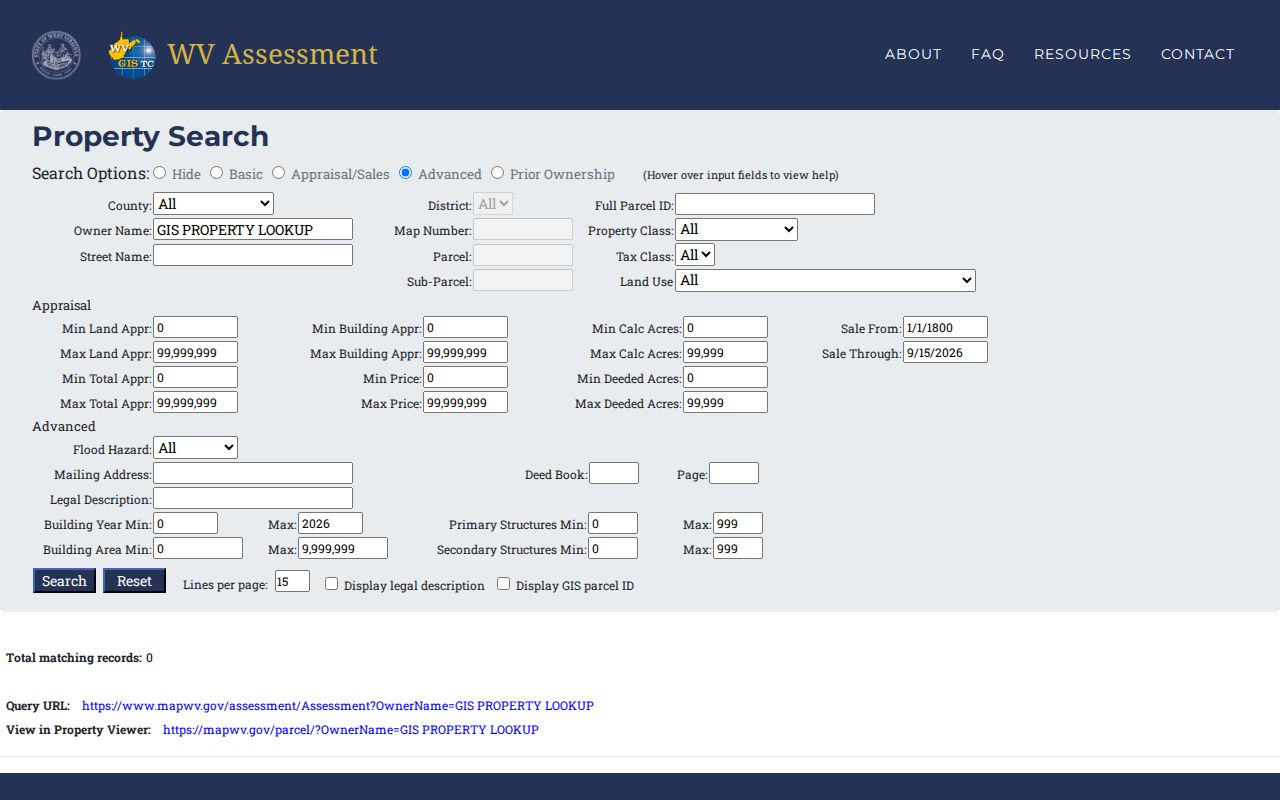
Use the appraisal and sale filters to find records, then compare the card's tax year and deed reference before interpreting the figures.
Tax Class and Special Use Behind a Pocahontas County Value
West Virginia sorts property into classes. Class II covers qualifying owner-occupied residences. Classes III and IV apply to other property depending on location. The county Assessor also administers homestead exemption, farm-use valuation and managed-timberland programs. Each one can change the taxable value or tax treatment. Two parcels with near-identical structures may still show very different tax pictures.
The Assessor's material covers floodplain determinations too. It says a determination must be filed before structures are built. Don't infer a special value from a rural or town address. Check the official form and the parcel's recorded use instead.
Recorded Sale Price and Pocahontas County Property Value
A recorded sale price is history, not news. It shows what one buyer paid on one day. The WV Assessment Search makes price work easier. You can filter Pocahontas County sales by sale date, sale price, and deeded acres, while the County Clerk holds the transfer instrument itself. Match the parcel before you compare. Confirm the deed describes the same parcel, and note whether the sale came before or after the July 1 valuation date. Some prices are not market signals. A family transfer, partial conveyance, or land split may look nothing like an open-market sale. The portal's property search lists prior owners, sale dates, prices, and deed information, but it publishes no neighborhood-comparable report or Pocahontas-specific revaluation trend, so a claim that one area is appreciating faster deserves doubt.
What a Pocahontas County Assessment Value Does Not Tell You
An assessment serves the tax roll, not the market. It is anchored to a statutory valuation date and a statewide relationship. A later market shift can pass it by. So can a property's unusual features. A recorded sale price has its own limits, since it reports a prior transaction rather than a fresh appraisal. The Assessor maintains appraisal fields for the tax roll. Those fields feed the roll; they are not an individual valuation report for a purchase or a loan.
Assessed is not market. A Pocahontas County property value on the tax roll is not an appraisal of today's sale price. For a transaction decision, use a qualified valuation professional.
WV Assessment breaks property data into separate filterable fields. Land appraisal, building appraisal, and total appraisal sit alongside calculated acres, deeded acres, sale date, and sale price. Read each value on its own terms. Calculated area and deeded area can disagree because the two field names draw on different record sources. A deed price has traps too. It may cover only part of the acreage, or reflect a transfer unlike an ordinary open-market sale. The public search exists to find and compare records. It does not offer a valuation opinion about the property.
Start any comparison with the parcel's legal description and tax class. Then check the sale date against July 1 and the assessed tax year. Class II marks qualifying owner-occupied residential property. Classes III and IV cover other property, depending on location. Homestead, farm-use, and managed-timberland treatment also shift tax results. These classifications organize the roll, but they cannot convert an assessed figure into a current asking price or prove two parcels are alike.
The county map notice offers one more lead. It points to “View Mapcard (Sales History)” for transfers recorded after its July 1, 2025 data collection for the 2026 assessment. Try that route when a recent deed is missing. Then verify the instrument with the County Clerk. Treat the sale fields as dated context rather than an automatic update to the tax roll.